

Voters Guide
Your Vote. Your Voice. Your Future.
Voting is one way to help shape decisions that affect your life, your community, and the people you care about.
The Arc of Indiana and Self-Advocates of Indiana created the 2026 Voters Guide to help Hoosiers with intellectual and developmental disabilities (IDD), their families, caregivers, and supporters understand the voting process, know their rights, and make informed decisions.
The Arc of Indiana is nonpartisan. We do not endorse political parties or candidates. Our goal is to provide information that helps you make your own choices.
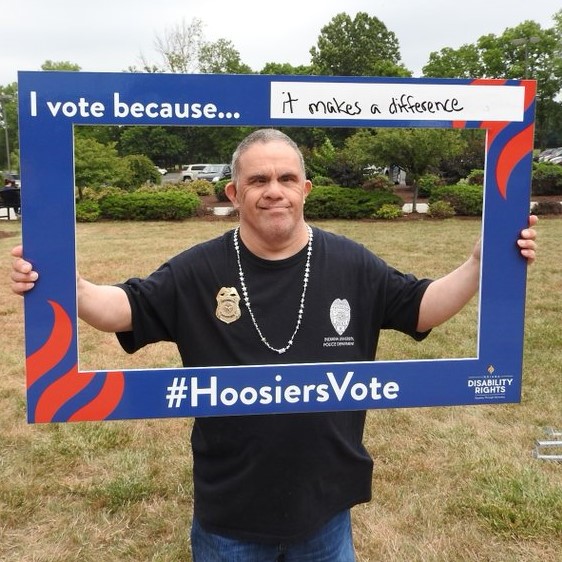
Your Vote Belongs to You
Voting is a personal choice. No one can tell you who to vote for or force you to vote a certain way—not a family member, guardian, support staff member, service provider, or friend.
Voters with disabilities also have rights to accessible voting locations, equipment, privacy, and assistance when needed.
Make a Plan to Vote
Knowing what to expect can help you feel prepared.
Before voting, take time to check your registration, find your polling location, learn who’s on your ballot, and make arrangements for transportation or assistance if needed.
The 2026 General Election is Tuesday, November 3. Indiana polling locations are open from 6 AM to 6 PM, local time. If you’re in line before 6 PM, you can still vote.
The Indiana Voter Portal provides official information to help you prepare.
Understanding Parties
What do the different political parties stand for?
Political parties bring together people who share beliefs about government and the issues that matter most. Indiana voters may see candidates from several political parties running for federal, state, and local offices.
Explore the parties represented in Indiana’s 2026 elections to learn about their priorities and positions. Remember, candidates within the same party may not agree on every issue.
Interested in finding your political party? Read about each below.
Across the state of Indiana in the 2026 Primaries the following parties were represented.

Democratic Party
The Indiana Democratic Party emphasizes affordable healthcare, public education, workers’ rights, and expanding economic opportunity. Its priorities include addressing housing and childcare costs, protecting civil rights, and supporting public investments intended to improve the well-being of Hoosier families and communities.

Republican Party
The Indiana Republican Party emphasizes limited government, lower taxes, individual responsibility, and free-market economics. Its platform also outlines positions on constitutional rights, public safety, education, traditional values, government spending, and the responsibilities of state and federal government.

American Solidarity Party
The American Solidarity Party draws on Christian democratic principles, emphasizing human dignity, family and community life, economic justice, and care for vulnerable people. Its platform supports affordable healthcare and housing, workers’ rights, environmental stewardship, and a consistent approach to protecting human life.

Green Party
The Green Party emphasizes environmental protection, social and economic justice, grassroots democracy, and nonviolence. Its platform supports action on climate change, renewable energy, healthcare access, workers’ rights, and changes to elections intended to give voters more choices and representation.

Independents & Nonpartisan
Some candidates run as independents, meaning they are not affiliated with a political party.
Some elections, including many school board races, are nonpartisan, meaning candidates do not run under a party label on the ballot.

Libertarian Party
The Libertarian Party emphasizes individual freedom, personal responsibility, free markets, and limited government. Its principles focus on protecting civil liberties, respecting individual choices, reducing government involvement in personal and economic matters, and allowing people to live their lives without unnecessary restrictions.

Lincoln Party
The Lincoln Party emphasizes ethical leadership, government accountability, individual liberty, and respect for democratic institutions. Its stated principles focus on fair elections, responsible government spending, public service, and practical problem-solving, while encouraging candidates to approach disagreements with honesty and respect.

Socialist Party of Indiana
The Socialist Party of Indiana emphasizes workers’ rights, economic equality, affordable housing, and public services. Its priorities include higher wages, stronger public schools, universal healthcare, worker participation in economic decisions, and reducing the influence of large corporations and wealthy donors in government.
Where Do Candidates Stand on Disability Issues?
Decisions made by elected officials can affect Medicaid, home and community-based services, employment, accessible housing, transportation, disability rights, and many other issues important to Hoosiers with disabilities.
As part of our 2026 Voters Guide, The Arc of Indiana reached out to candidates running for Indiana’s nine U.S. House of Representatives seats and Secretary of State.
We asked questions about issues affecting people with disabilities and their families and invited candidates to share their perspectives.
Below, you can explore the responses we received to help you consider where candidates stand on issues that matter to you.
2026 Candidate Responses
U.S. House of Representatives
Federal Office · Districts 1–9
Not sure which district you’re in? Use the “Find My Legislator” guide to learn what congressional and state district you live in.
Congressional District 1– Northwest Indiana
Lake County (all), Porter County (all), LaPorte County (partial)
Question 1 – Would you support federal legislation to make Home and Community-Based Services a mandatory Medicaid benefit? Why or why not?
Response: I am a strong supporter of Medicaid, and believe that this program, including HCBS benefits, provides essential health coverage to low-income families and individuals, including children, seniors, and people with disabilities. That is why I opposed P.L. 119-21, the Republican budget reconciliation legislation, a generational sabotage on our communities that prioritizes tax breaks for the wealthy at the cruel expense of healthcare for seniors, veterans, children and working families all while raising the deficit by $3.4 trillion. Specific to legislation, I will continue to work to reverse the damaging impacts of the reconciliation law on the Medicaid program and welcome further discussions with advocates, policy experts, and my colleagues on the appropriate House Committees of jurisdiction regarding HCBS specific legislation.
Question 2 – Supplemental Security Income (SSI)
Do you believe the current SSI resource limits should be increased, indexed for inflation, or otherwise reformed? Why or why not?
Response: I am fighting every day to protect Social Security and SSI benefits and ensure that these critical programs are able to continue to provide income security for older Americans and those with disabilities. That is why I am proud cosponsor of H.R. 2540, the SSI Savings Penalty Elimination Act, which would increase the asset limit for receiving SSI benefits for the first time in decades.
About SSI
Supplemental Security Income (SSI) provides a modest cash benefit for low-income individuals who are elderly, blind, or have disabilities. While costs for basic necessities have increased over the years, SSI’s asset limits have not kept pace with inflation and have remained largely unchanged since 1989. An individual on SSI generally cannot have more than $2,000 in countable resources at any time. Married couples are only allowed $3,000. Resources that count towards the SSI asset limit include cash, money in bank accounts, stocks and bonds, and certain other assets.
Question 3 – Direct Support Professional (DSP) Crisis
What federal policies would you support to strengthen the Direct Support Professional workforce, including recruitment, retention, compensation, and support for family caregivers?
Response: You should know that I am a supporter and cosponsor of H.R. 2036, the Credit for Caring Act of 2025, which would allow an eligible family caregiver a tax credit of up to $5,000 for 30 percent of the cost of long-term care expenses that exceed $2,000 in a taxable year. Additionally, as a member of the House Appropriations Committee, I am continuing to work to support funding and programs under the Administration for Community Living for family caregivers.
About the DSP Crisis
Direct Support Professionals (DSPs) provide essential support that allows individuals with intellectual and developmental disabilities to live, work, and participate in their communities. However, the profession continues to experience chronic workforce shortages driven by low wages, limited benefits, and high turnover. Nationally, DSP turnover exceeds 40% annually, and many providers report vacancy rates that leave critical positions unfilled. These workforce shortages contribute to service disruptions, increased caregiver strain, longer waiting lists for waivers, and reduced access to Home and Community Based Services (HCBS).
Question 4 – Seclusion and Restraint
What would you do to address issues of seclusion and restraint in schools for students with disabilities?
Response: I firmly believe that we must ensure our schools are a safe learning environment for all students, including those with developmental disabilities. This is why I am a cosponsor of H.R. 6617, the Keeping All Students Safe Act, which would prohibit any school receiving federal funding from implementing dangerous restraint and seclusion practices against students. The measure would further provide grants to train school personnel to address school-expected behavior with evidence-based, proactive strategies and would increase transparency and oversight to ensure student safety.
About Seclusion and Restraint
Seclusion and restraint are crisis intervention practices used in some schools across the nation. Seclusion generally involves involuntarily confining a student alone in a room or area from which the student is physically prevented from leaving. Restraint may involve physical, mechanical, or chemical interventions that restrict a student’s movement.
Students with disabilities are disproportionately subjected to seclusion and restraint practices. Disability advocates have raised concerns regarding safety, trauma, transparency, accountability, and the use of these interventions when less restrictive alternatives may be available.
Question 5 – Housing
What federal policies would you support to expand safe, affordable, accessible, and integrated housing opportunities for people with disabilities?
Response: In general, I remain concerned that so many Americans are struggling to keep a roof over their heads, and I strongly support investing in critical affordable housing development programs to expand access to safe, quality affordable housing in Northwest Indiana and across the country. I am committed to ensuring housing services are available to our most vulnerable populations, including individuals with disabilities. That is why as a Member of the House Appropriations Committee, I am advocating for continued investments in several housing assistance and development programs, including the Community Development Block Grant Program, the HOME Investment Partnerships Program, the Housing Choice Voucher Program, fair housing and housing counseling assistance programs, and homelessness assistance grants.
About Housing
People with intellectual and developmental disabilities (IDD) face a housing crisis, with many contributing factors, such as a serious lack of safe, affordable, accessible and integrated housing, and significant housing-related discrimination. Access to stable housing is essential to community integration, employment, health, and quality of life.
Question 6 – What actions would you take to improve the availability, accessibility, reliability, and affordability of transportation options for people with disabilities?
Response: As your member of Congress, I am committed to working with all levels of government and Northwest Indiana community stakeholders to help identify opportunities to improve transportation options for all individuals and ensure that federal transportation investment dollars are used in ways to promote accessibility for all individuals with disabilities. I look forward to continuing to listen to organizations such as the Arc of Indiana, as well as my Congressional colleagues and policy experts, on such legislative opportunities and policy proposals as we move forward.
About Transportation
People with IDD lack sufficient access to reliable, accessible, and safe modes of public and private transportation. Every mode of transportation, including air, water, road, rail, and even pedestrian transportation, presents barriers for individuals with IDD. These barriers prevent people with IDD from meaningful participation in everyday activities that promote high-quality community living experiences.
Reliable and accessible transportation is essential for people with disabilities to access employment, education, health care, community activities, and other opportunities. Transportation limitations can significantly restrict independence and community participation.
Republican- Barb Regnitz
No Responses Submitted by Candidate
District 2– North-Central Indiana
Cass County (partial), Elkhart County (all), Fulton County (all), Kosciusko County (partial), Marshall County (all), Miami County (all), Pulaski County (all), St. Joseph County (all), Starke County(all), Wabash County (all)
Question 1 – Would you support federal legislation to make Home and Community-Based Services a mandatory Medicaid benefit? Why or why not?
Response: Yes. I think that most seniors would rather remain at home with loved ones instead of assisted living or another facility because they want to be near family. I suspect there are stats that prove that patients who remain home have a better quality of life. I’ve been to enough of these facilities and all you see is a patient alone with little or not interaction. When they can be cared for at home, I strongly suspect they are more engaged and content.
Question 2 – Supplemental Security Income (SSI)
Do you believe the current SSI resource limits should be increased, indexed for inflation, or otherwise reformed? Why or why not?
Response: Yes, SSI should be increased based on inflation rate.
About SSI
Supplemental Security Income (SSI) provides a modest cash benefit for low-income individuals who are elderly, blind, or have disabilities. While costs for basic necessities have increased over the years, SSI’s asset limits have not kept pace with inflation and have remained largely unchanged since 1989. An individual on SSI generally cannot have more than $2,000 in countable resources at any time. Married couples are only allowed $3,000. Resources that count towards the SSI asset limit include cash, money in bank accounts, stocks and bonds, and certain other assets.
Question 3 – Direct Support Professional (DSP) Crisis
What federal policies would you support to strengthen the Direct Support Professional workforce, including recruitment, retention, compensation, and support for family caregivers?
Response: To retain direct support professionals, I would recruit and raise their compensation. Home and community-based services need reliable and professional workers. To maintain staff support, I would provide universal healthcare. I would also include working with family caregivers.
About the DSP Crisis
Direct Support Professionals (DSPs) provide essential support that allows individuals with intellectual and developmental disabilities to live, work, and participate in their communities. However, the profession continues to experience chronic workforce shortages driven by low wages, limited benefits, and high turnover. Nationally, DSP turnover exceeds 40% annually, and many providers report vacancy rates that leave critical positions unfilled. These workforce shortages contribute to service disruptions, increased caregiver strain, longer waiting lists for waivers, and reduced access to Home and Community Based Services (HCBS).
Question 4 – Seclusion and Restraint
What would you do to address issues of seclusion and restraint in schools for students with disabilities?
Response: I am not a fan of seclusion and restraint, especially leaving a student alone. Students with trauma require higher care and need trained intervention. I believe it’s always better to use less restrictive alternative actions.
About Seclusion and Restraint
Seclusion and restraint are crisis intervention practices used in some schools across the nation. Seclusion generally involves involuntarily confining a student alone in a room or area from which the student is physically prevented from leaving. Restraint may involve physical, mechanical, or chemical interventions that restrict a student’s movement.
Students with disabilities are disproportionately subjected to seclusion and restraint practices. Disability advocates have raised concerns regarding safety, trauma, transparency, accountability, and the use of these interventions when less restrictive alternatives may be available.
Question 5 – Housing
What federal policies would you support to expand safe, affordable, accessible, and integrated housing opportunities for people with disabilities?
Response: I would support a bill providing safe and affordable housing for people with disabilities if they are able to live independently.
About Housing
People with intellectual and developmental disabilities (IDD) face a housing crisis, with many contributing factors, such as a serious lack of safe, affordable, accessible and integrated housing, and significant housing-related discrimination. Access to stable housing is essential to community integration, employment, health, and quality of life.
Question 6 – What actions would you take to improve the availability, accessibility, reliability, and affordability of transportation options for people with disabilities?
Response: I would include transportation in a bill that would address housing and promote independence. People with disabilities need opportunities. They don’t need to be restricted by their disabilities. They need assistance so they can be employed, reside, and live independently.
About Transportation
People with IDD lack sufficient access to reliable, accessible, and safe modes of public and private transportation. Every mode of transportation, including air, water, road, rail, and even pedestrian transportation, presents barriers for individuals with IDD. These barriers prevent people with IDD from meaningful participation in everyday activities that promote high-quality community living experiences.
Reliable and accessible transportation is essential for people with disabilities to access employment, education, health care, community activities, and other opportunities. Transportation limitations can significantly restrict independence and community participation.
Republican- Rudy Yakym (Incumbent)
No Responses Submitted by Candidate
Independent- William Henry
No Responses Submitted by Candidate
District 3– Northeast Indiana
Adams County (all), Allen County (all), Blackford County (all), DeKalb County (all), Huntington County (all), Jay County (partial), Kosciusko County (partial), LaGrange County (all), Noble County (all), Steuben County (all), Wells County (all), Whitley County (all)
Question 1 – Would you support federal legislation to make Home and Community-Based Services a mandatory Medicaid benefit? Why or why not?
Response: Yes. Because Medicaid currently forces seniors and people with disabilities to go without care or get warehoused in nursing homes while home and community-based services stay an optional benefit that states can cut whenever budgets get tight, I support making HCBS a mandatory Medicaid benefit – guaranteeing every person the right to receive care in their own home and community instead of being institutionalized against their wishes.
Question 2 – Supplemental Security Income (SSI)
Do you believe the current SSI resource limits should be increased, indexed for inflation, or otherwise reformed? Why or why not?
Response: Because the SSI asset limit has been frozen at just $2,000 for an individual since 1989 and has lost most of its real value to inflation, trapping recipients in poverty and punishing them for saving even modestly, I believe SSI resource limits must be raised substantially and indexed to inflation going forward so beneficiaries can build basic financial security without losing the benefits upon which they depend.
About SSI
Supplemental Security Income (SSI) provides a modest cash benefit for low-income individuals who are elderly, blind, or have disabilities. While costs for basic necessities have increased over the years, SSI’s asset limits have not kept pace with inflation and have remained largely unchanged since 1989. An individual on SSI generally cannot have more than $2,000 in countable resources at any time. Married couples are only allowed $3,000. Resources that count towards the SSI asset limit include cash, money in bank accounts, stocks and bonds, and certain other assets.
Question 3 – Direct Support Professional (DSP) Crisis
What federal policies would you support to strengthen the Direct Support Professional workforce, including recruitment, retention, compensation, and support for family caregivers?
Response: I would support federal policies that raise Medicaid reimbursement rates tied to DSP wages, establish a national wage floor and career ladder with training and credentialing pathways for DSPs, fund recruitment and retention grants to address the workforce shortage, and expand caregiver support through paid family leave, respite care funding, and increased compensation options for family caregivers providing the same essential care.
About the DSP Crisis
Direct Support Professionals (DSPs) provide essential support that allows individuals with intellectual and developmental disabilities to live, work, and participate in their communities. However, the profession continues to experience chronic workforce shortages driven by low wages, limited benefits, and high turnover. Nationally, DSP turnover exceeds 40% annually, and many providers report vacancy rates that leave critical positions unfilled. These workforce shortages contribute to service disruptions, increased caregiver strain, longer waiting lists for waivers, and reduced access to Home and Community Based Services (HCBS).
Question 4 – Seclusion and Restraint
What would you do to address issues of seclusion and restraint in schools for students with disabilities?
Response: I would support federal legislation to ban the use of seclusion in schools entirely, replacing it with positive behavioral supports, trauma-informed training for educators, adequately staffed special education programs, and mandatory reporting and oversight requirements so students with disabilities are never isolated or restrained as a substitute for. proper care and support.
About Seclusion and Restraint
Seclusion and restraint are crisis intervention practices used in some schools across the nation. Seclusion generally involves involuntarily confining a student alone in a room or area from which the student is physically prevented from leaving. Restraint may involve physical, mechanical, or chemical interventions that restrict a student’s movement.
Students with disabilities are disproportionately subjected to seclusion and restraint practices. Disability advocates have raised concerns regarding safety, trauma, transparency, accountability, and the use of these interventions when less restrictive alternatives may be available.
Question 5 – Housing
What federal policies would you support to expand safe, affordable, accessible, and integrated housing opportunities for people with disabilities?
Response: I would support federal policies that significantly expand funding for Section 811 supportive housing and housing vouchers dedicated to people with disabilities, enforce and strengthen Olmstead and fair housing protections against institutional bias, incentivize the development of accessible and universally designed affordable units, and increase funding to help people transition from institutions into integrated homes and communities of their own choosing.
About Housing
People with intellectual and developmental disabilities (IDD) face a housing crisis, with many contributing factors, such as a serious lack of safe, affordable, accessible and integrated housing, and significant housing-related discrimination. Access to stable housing is essential to community integration, employment, health, and quality of life.
Question 6 – What actions would you take to improve the availability, accessibility, reliability, and affordability of transportation options for people with disabilities?
Response: As a congresswoman, I would push to increase federal funding for accessible paratransit and public transit systems, strengthen and enforce ADA compliance requirements for transportation providers, expand rural and community transportation grants so people with disabilities outside major cities aren’t stranded, and support subsidies and incentives that make accessible vehicles, ride-share options, and infrastructure upgrades more affordable and reliable nationwide.
About Transportation
People with IDD lack sufficient access to reliable, accessible, and safe modes of public and private transportation. Every mode of transportation, including air, water, road, rail, and even pedestrian transportation, presents barriers for individuals with IDD. These barriers prevent people with IDD from meaningful participation in everyday activities that promote high-quality community living experiences.
Reliable and accessible transportation is essential for people with disabilities to access employment, education, health care, community activities, and other opportunities. Transportation limitations can significantly restrict independence and community participation.
Question 1 – Would you support federal legislation to make Home and Community-Based Services a mandatory Medicaid benefit? Why or why not?
Response: The candidate did not respond to this question.
Question 2 – Supplemental Security Income (SSI)
Do you believe the current SSI resource limits should be increased, indexed for inflation, or otherwise reformed? Why or why not?
Response: The candidate did not respond to this question.
About SSI
Supplemental Security Income (SSI) provides a modest cash benefit for low-income individuals who are elderly, blind, or have disabilities. While costs for basic necessities have increased over the years, SSI’s asset limits have not kept pace with inflation and have remained largely unchanged since 1989. An individual on SSI generally cannot have more than $2,000 in countable resources at any time. Married couples are only allowed $3,000. Resources that count towards the SSI asset limit include cash, money in bank accounts, stocks and bonds, and certain other assets.
Question 3 – Direct Support Professional (DSP) Crisis
What federal policies would you support to strengthen the Direct Support Professional workforce, including recruitment, retention, compensation, and support for family caregivers?
Response: Direct Support Professionals and other caregivers provide essential services to people with disabilities. These individuals sometimes serve as the gateway for participation in the workforce and the community. There are many great organizations that provide this assistance in Indiana’s Third District; I support ways to not only uplift these organizations, but also assist in recruiting qualified individuals for these jobs. DSPs have an incredible impact, and I believe more can be done to communicate this high-impact career pathway to those students who may not desire a traditional four year degree pathway.
About the DSP Crisis
Direct Support Professionals (DSPs) provide essential support that allows individuals with intellectual and developmental disabilities to live, work, and participate in their communities. However, the profession continues to experience chronic workforce shortages driven by low wages, limited benefits, and high turnover. Nationally, DSP turnover exceeds 40% annually, and many providers report vacancy rates that leave critical positions unfilled. These workforce shortages contribute to service disruptions, increased caregiver strain, longer waiting lists for waivers, and reduced access to Home and Community Based Services (HCBS).
Question 4 – Seclusion and Restraint
What would you do to address issues of seclusion and restraint in schools for students with disabilities?
Response: Ultimately, every child with disabilities has a unique set of needs to be met while at school. Each student’s parents should ultimately and always have a say in how difficult situations are handled with their child before they arise. I would encourage local schools and subsequent policies to always involve parents in these conversations. Seclusion and restraint should never be the go-to, and I encourage school district staff to engage with parents on ways to handle difficult situations. Parents and caregivers will always know how best to care for their children.
About Seclusion and Restraint
Seclusion and restraint are crisis intervention practices used in some schools across the nation. Seclusion generally involves involuntarily confining a student alone in a room or area from which the student is physically prevented from leaving. Restraint may involve physical, mechanical, or chemical interventions that restrict a student’s movement.
Students with disabilities are disproportionately subjected to seclusion and restraint practices. Disability advocates have raised concerns regarding safety, trauma, transparency, accountability, and the use of these interventions when less restrictive alternatives may be available.
Question 5 – Housing
What federal policies would you support to expand safe, affordable, accessible, and integrated housing opportunities for people with disabilities?
Response: This Congress, I helped to pass the 21st Century ROAD to Housing Act, which expanded avenues to build our nation’s housing supply for all Americans. One of my bills, the Streamlining Rural Housing Act, was included in this package and signed into law. This bill would require the Department of Housing and Urban Development (HUD) to enter into a memorandum of understanding with the Department of Agriculture to streamline the regulatory process for starting housing projects funded by either agency. Some of these projects, specifically funded by HUD, are required to have units accessible to those with mobility, hearing, and/or vision impairments.
I was happy to have my bill included in this package to further support the availability of housing for those with disabilities, and I look forward to advancing other policies to continue this effort.
About Housing
People with intellectual and developmental disabilities (IDD) face a housing crisis, with many contributing factors, such as a serious lack of safe, affordable, accessible and integrated housing, and significant housing-related discrimination. Access to stable housing is essential to community integration, employment, health, and quality of life.
Question 6 – What actions would you take to improve the availability, accessibility, reliability, and affordability of transportation options for people with disabilities?
Response: Having transportation to the store, doctors’ appointments, church events, and more is vital in today’s society. Those with disabilities should not be left behind because transportation doesn’t exist to serve their needs. Non-profits and organizations within our communities know best how to meet these transportation needs. I am proud to know many organizations in Indiana’s Third District that perform this work, including transportation for those who cannot drive. I support ways to encourage assistance to these pivotal services to better serve our community.
About Transportation
People with IDD lack sufficient access to reliable, accessible, and safe modes of public and private transportation. Every mode of transportation, including air, water, road, rail, and even pedestrian transportation, presents barriers for individuals with IDD. These barriers prevent people with IDD from meaningful participation in everyday activities that promote high-quality community living experiences.
Reliable and accessible transportation is essential for people with disabilities to access employment, education, health care, community activities, and other opportunities. Transportation limitations can significantly restrict independence and community participation.
District 4– West-Central/Northwest-Central Indiana
Benton County (all), Boone County (all), Carroll County (all), Cass County (partial), Clinton County (all), Fountain County (partial), Hendricks County (all), Howard County (partial), Jasper County (all), Montgomery County (all), Morgan County (all), Newton County (all), Putnam County (all), Tippecanoe County (all), Warren County (all), White County (all)
Democratic- Drew Cox
No Responses Submitted by Candidate
Republican- Jim Baird (Incumbent)
No Responses Submitted by Candidate
District 5– North Indianapolis Suburbs
Hamilton County (all), Madison County (all), Delaware County (all), Grant County (all), Tipton County (all), Howard County (partial)
Question 1 – Would you support federal legislation to make Home and Community-Based Services a mandatory Medicaid benefit? Why or why not?
Response: The candidate did not respond to this question.
Question 2 – Supplemental Security Income (SSI)
Do you believe the current SSI resource limits should be increased, indexed for inflation, or otherwise reformed? Why or why not?
Response: Yes, SSI asset limits should be reformed to reflect the modern economy and cost of living, then indexed for inflation from that point. While SSI is meant as a resource for low-income individuals, we should not be discouraging people from saving for emergencies. $3,000 in the bank will not pull someone out of poverty, but it will replace a refrigerator, help with an unexpected medical bill or cover car repairs. Our elderly and people with disabilities have just as much a right as other Americans to have money in the bank for emergencies while also being able to make ends meet every month. Forcing people into poverty as an eligibility criteria isn’t assistance, it only makes things harder for families.
About SSI
Supplemental Security Income (SSI) provides a modest cash benefit for low-income individuals who are elderly, blind, or have disabilities. While costs for basic necessities have increased over the years, SSI’s asset limits have not kept pace with inflation and have remained largely unchanged since 1989. An individual on SSI generally cannot have more than $2,000 in countable resources at any time. Married couples are only allowed $3,000. Resources that count towards the SSI asset limit include cash, money in bank accounts, stocks and bonds, and certain other assets.
Question 3 – Direct Support Professional (DSP) Crisis
What federal policies would you support to strengthen the Direct Support Professional workforce, including recruitment, retention, compensation, and support for family caregivers?
Response: In Congress, I will support the Recognizing the Role of Direct Support Professionals Act to create a unique occupational code for DSPs and better address the chronic workforce shortage. I also will support funding to ensure our DSPs make a living wage, as we will not be able to fully solve shortages in staff for home-based care if professionals can make more by going to work in retail or food service. DSP wages must reflect the importance of the work they do for our families and communities.
About the DSP Crisis
Direct Support Professionals (DSPs) provide essential support that allows individuals with intellectual and developmental disabilities to live, work, and participate in their communities. However, the profession continues to experience chronic workforce shortages driven by low wages, limited benefits, and high turnover. Nationally, DSP turnover exceeds 40% annually, and many providers report vacancy rates that leave critical positions unfilled. These workforce shortages contribute to service disruptions, increased caregiver strain, longer waiting lists for waivers, and reduced access to Home and Community Based Services (HCBS).
Question 4 – Seclusion and Restraint
What would you do to address issues of seclusion and restraint in schools for students with disabilities?
Response: The Individuals with Disabilities Education Act guarantees students with disabilities the right to learn in the least restrictive environment. This means student interventions should be trauma informed and use the least restrictive means necessary. I absolutely do not support interventions that involuntarily confine and/or isolate students with disabilities, and condemn this discriminatory behavior. In Congress, I will support the Keeping All Students Safe Act to prohibit schools that receive federal funding from secluding or restraining students. I support providing the resources needed to properly train educators and other school personnel on effective and appropriate interventions. I also support expanding the Keeping All Students Safe Act to private schools. All children should be safe at school – no matter the source of that school’s funding.
About Seclusion and Restraint
Seclusion and restraint are crisis intervention practices used in some schools across the nation. Seclusion generally involves involuntarily confining a student alone in a room or area from which the student is physically prevented from leaving. Restraint may involve physical, mechanical, or chemical interventions that restrict a student’s movement.
Students with disabilities are disproportionately subjected to seclusion and restraint practices. Disability advocates have raised concerns regarding safety, trauma, transparency, accountability, and the use of these interventions when less restrictive alternatives may be available.
Question 5 – Housing
What federal policies would you support to expand safe, affordable, accessible, and integrated housing opportunities for people with disabilities?
Response: First, I support requiring states to fully fund their Medicaid waivers with no waitlist to ensure our constituents with intellectual and developmental disabilities receive the housing resources they need – whether that’s in their home or in a residential setting. I support federal legislation to require that everyone with a disability makes at least the federal minimum wage at their jobs so they can better afford housing. It is offensive that our government officially deems work by those with disabilities as “less than” – this must change. I support better resources for enforcing and stronger penalties for violating our non-discrimination laws. I support the Whole Home Repair pilot project included in the recently passed 21st Century Road to Housing Act. In Congress, I will support funding for the projects created in that Act and will take seriously the recommendations provided in the upcoming Government Accountability Office’s 2027 report on removing housing barriers and improving housing for older and disabled people.
About Housing
People with intellectual and developmental disabilities (IDD) face a housing crisis, with many contributing factors, such as a serious lack of safe, affordable, accessible and integrated housing, and significant housing-related discrimination. Access to stable housing is essential to community integration, employment, health, and quality of life.
Question 6 – What actions would you take to improve the availability, accessibility, reliability, and affordability of transportation options for people with disabilities?
Response: Indianapolis and most of Indiana lack adequate public transportation options, which puts those who cannot use private transportation at a distinct and unfair disadvantage. That’s why, as a State Senator, I fought for improved transportation services provided as part of Medicaid. I also stood against every effort to block the construction of the Bus Rapid Transit system in Indianapolis. I will support similar policies in Washington, D.C., such as providing communities with grants to modernize their transit infrastructure to include items such as wheelchair ramps and securement devices, require transit systems to offer same day paratransit options and enact stronger expectations of airline and rail companies for training their staff on assisting people with disabilities.
About Transportation
People with IDD lack sufficient access to reliable, accessible, and safe modes of public and private transportation. Every mode of transportation, including air, water, road, rail, and even pedestrian transportation, presents barriers for individuals with IDD. These barriers prevent people with IDD from meaningful participation in everyday activities that promote high-quality community living experiences.
Reliable and accessible transportation is essential for people with disabilities to access employment, education, health care, community activities, and other opportunities. Transportation limitations can significantly restrict independence and community participation.
Republican- Victoria Spartz (Incumbent)
No Responses Submitted by Candidate
District 6– East-Central Indiana/Southeast Indiana
Bartholomew County (partial), Fayette County (all), Hancock County (all), Henry County (all), Johnson County (all), Marion County (partial), Randolph County (partial), Rush County (all), Shelby County (all), Union County (all), Wayne County (all)
Question 1 – Would you support federal legislation to make Home and Community-Based Services a mandatory Medicaid benefit? Why or why not?
Response: Yes. I support making Home and Community-Based Services a mandatory Medicaid benefit. People should not have to wait years for the support they need to live safely at home, work, attend school, and participate in their communities. It is wrong that nursing facility care is guaranteed through Medicaid while most community-based services remain optional, leaving families on long waiting lists and forcing people into institutional settings. Federal legislation should guarantee HCBS, fully fund the transition, and help states recruit and retain the direct-care workforce through fair wages, benefits, and training. Family caregivers also need respite and support. Living in the community should be a right, not a privilege determined by a state waiver or a waiting list.
Question 2 – Supplemental Security Income (SSI)
Do you believe the current SSI resource limits should be increased, indexed for inflation, or otherwise reformed? Why or why not?
Response: Yes. SSI resource limits must be raised and indexed to inflation. The current $2,000 limit for an individual and $3,000 limit for a married couple have not changed since 1989. That is not enough to cover a car repair, medical expense, accessible housing need, or broken appliance. No one should lose essential benefits because they saved a small emergency fund. As a teacher, I know financial instability affects every part of a person’s life. We should support independence, not punish people for modest savings. I support increasing limits to at least $10,000 for individuals and $20,000 for couples, with automatic inflation adjustments.
About SSI
Supplemental Security Income (SSI) provides a modest cash benefit for low-income individuals who are elderly, blind, or have disabilities. While costs for basic necessities have increased over the years, SSI’s asset limits have not kept pace with inflation and have remained largely unchanged since 1989. An individual on SSI generally cannot have more than $2,000 in countable resources at any time. Married couples are only allowed $3,000. Resources that count towards the SSI asset limit include cash, money in bank accounts, stocks and bonds, and certain other assets.
Question 3 – Direct Support Professional (DSP) Crisis
What federal policies would you support to strengthen the Direct Support Professional workforce, including recruitment, retention, compensation, and support for family caregivers?
Response: Direct Support Professionals help people with disabilities live independently, yet too many earn poverty wages, lack benefits, and leave due to burnout. That is unacceptable. I support federal Medicaid funding tied to higher wages, health coverage, paid leave, and career pathways through training and apprenticeships. We must recognize DSPs as a distinct workforce and hold providers accountable. Families need support too. I support expanded home- and community-based services, paid family caregiving, reliable respite care, and caregiver training. People with disabilities deserve stable care. DSPs deserve fair pay and respect.
About the DSP Crisis
Direct Support Professionals (DSPs) provide essential support that allows individuals with intellectual and developmental disabilities to live, work, and participate in their communities. However, the profession continues to experience chronic workforce shortages driven by low wages, limited benefits, and high turnover. Nationally, DSP turnover exceeds 40% annually, and many providers report vacancy rates that leave critical positions unfilled. These workforce shortages contribute to service disruptions, increased caregiver strain, longer waiting lists for waivers, and reduced access to Home and Community Based Services (HCBS).
Question 4 – Seclusion and Restraint
What would you do to address issues of seclusion and restraint in schools for students with disabilities?
Response: Students with disabilities deserve safety, dignity, and a school environment built for their success. Seclusion and restraint should never be used as punishment, discipline, or a substitute for adequate staffing and support. I support federal standards that prohibit seclusion and mechanical or chemical restraints, while limiting physical restraint to true emergencies involving imminent risk of serious harm. Schools must notify families immediately, document every incident, and report data publicly. We must invest in trauma-informed training, de-escalation, mental health staff, and positive behavioral supports. As a teacher, I know prevention, relationships, and proper resources protect students far better than isolation or force.
About Seclusion and Restraint
Seclusion and restraint are crisis intervention practices used in some schools across the nation. Seclusion generally involves involuntarily confining a student alone in a room or area from which the student is physically prevented from leaving. Restraint may involve physical, mechanical, or chemical interventions that restrict a student’s movement.
Students with disabilities are disproportionately subjected to seclusion and restraint practices. Disability advocates have raised concerns regarding safety, trauma, transparency, accountability, and the use of these interventions when less restrictive alternatives may be available.
Question 5 – Housing
What federal policies would you support to expand safe, affordable, accessible, and integrated housing opportunities for people with disabilities?
Response: People with disabilities deserve the freedom to choose where and how they live, in safe, affordable homes that are part of their communities. I support major federal investments in Housing Choice Vouchers, Section 811 supportive housing, and affordable housing construction. New federally supported housing should meet universal-design and accessibility standards, not force people to fight for basic accommodations. We must enforce fair housing laws and invest in community-based supports that help people live independently, rather than segregating them in institutions or isolated settings. Housing is not a luxury. It is the foundation for health, employment, community, and dignity.
About Housing
People with intellectual and developmental disabilities (IDD) face a housing crisis, with many contributing factors, such as a serious lack of safe, affordable, accessible and integrated housing, and significant housing-related discrimination. Access to stable housing is essential to community integration, employment, health, and quality of life.
Question 6 – What actions would you take to improve the availability, accessibility, reliability, and affordability of transportation options for people with disabilities?
Response: Transportation is freedom, and without it, people with disabilities can be shut out of work, school, health care, and community life. I support federal investments in accessible public transit, safer sidewalks and crossings, and reliable, affordable paratransit. Transit systems receiving federal dollars must meet ADA standards and provide service that is dependable, timely, and easy to use. We also need more transportation options in rural communities, because gaps there can be significant. Federal funding should support driver training, accessible vehicles, travel training, and coordination among transit, health care, and disability-service providers. People with disabilities deserve the independence to be able to get where they need to go.
About Transportation
People with IDD lack sufficient access to reliable, accessible, and safe modes of public and private transportation. Every mode of transportation, including air, water, road, rail, and even pedestrian transportation, presents barriers for individuals with IDD. These barriers prevent people with IDD from meaningful participation in everyday activities that promote high-quality community living experiences.
Reliable and accessible transportation is essential for people with disabilities to access employment, education, health care, community activities, and other opportunities. Transportation limitations can significantly restrict independence and community participation.
Republican- Jefferson Shreve (Incumbent)
No Responses Submitted by Candidate
District 7– Indianapolis
Marion County (partial)
Question 1 – Would you support federal legislation to make Home and Community-Based Services a mandatory Medicaid benefit? Why or why not?
Response: The candidate did not respond to this question.
Question 2 – Supplemental Security Income (SSI)
Do you believe the current SSI resource limits should be increased, indexed for inflation, or otherwise reformed? Why or why not?
Response: Yes, resource limits should be increased and indexed for inflation to improve the quality of life, health and well-being of SSI recipients.
About SSI
Supplemental Security Income (SSI) provides a modest cash benefit for low-income individuals who are elderly, blind, or have disabilities. While costs for basic necessities have increased over the years, SSI’s asset limits have not kept pace with inflation and have remained largely unchanged since 1989. An individual on SSI generally cannot have more than $2,000 in countable resources at any time. Married couples are only allowed $3,000. Resources that count towards the SSI asset limit include cash, money in bank accounts, stocks and bonds, and certain other assets.
Question 3 – Direct Support Professional (DSP) Crisis
What federal policies would you support to strengthen the Direct Support Professional workforce, including recruitment, retention, compensation, and support for family caregivers?
Response: Increasing the availability of qualified DSPs is critical for the well-being of individuals with disabilities and to expand job opportunities for these important professionals. I support programs that support expanded training and hiring of these professionals.
About the DSP Crisis
Direct Support Professionals (DSPs) provide essential support that allows individuals with intellectual and developmental disabilities to live, work, and participate in their communities. However, the profession continues to experience chronic workforce shortages driven by low wages, limited benefits, and high turnover. Nationally, DSP turnover exceeds 40% annually, and many providers report vacancy rates that leave critical positions unfilled. These workforce shortages contribute to service disruptions, increased caregiver strain, longer waiting lists for waivers, and reduced access to Home and Community Based Services (HCBS).
Question 4 – Seclusion and Restraint
What would you do to address issues of seclusion and restraint in schools for students with disabilities?
Response: Seclusion and restraint should be avoided and only used as a last resort – not an ongoing or routine pattern. If needed, it should be used for only a very limited time if no other option is available. It should not be the default. We need more resources and staffing for students with special needs to provide equal educational opportunities and experiences. Whether students have physical, intellectual or emotional challenges, we need adequate and quality resources to help every student learn and grow to their full potential.
About Seclusion and Restraint
Seclusion and restraint are crisis intervention practices used in some schools across the nation. Seclusion generally involves involuntarily confining a student alone in a room or area from which the student is physically prevented from leaving. Restraint may involve physical, mechanical, or chemical interventions that restrict a student’s movement.
Students with disabilities are disproportionately subjected to seclusion and restraint practices. Disability advocates have raised concerns regarding safety, trauma, transparency, accountability, and the use of these interventions when less restrictive alternatives may be available.
Question 5 – Housing
What federal policies would you support to expand safe, affordable, accessible, and integrated housing opportunities for people with disabilities?
Response: I’m a strong supporter of full and expanded funding for housing programs with supportive services and continuum of care, including HUD’s Sec. 8, Sec. 202, Sec. 811, HOPWA and Mainstream Vouchers. We need more affordable housing, including resources in the 21st Century ROAD to Housing Act, which I supported. But we must also strengthen and expand targeted programs for this community.
About Housing
People with intellectual and developmental disabilities (IDD) face a housing crisis, with many contributing factors, such as a serious lack of safe, affordable, accessible and integrated housing, and significant housing-related discrimination. Access to stable housing is essential to community integration, employment, health, and quality of life.
Question 6 – What actions would you take to improve the availability, accessibility, reliability, and affordability of transportation options for people with disabilities?
Response: As an active member of the Transportation and Infrastructure Committee, I believe that transportation is a civil right. I strongly supported the Bipartisan Infrastructure Law which provided more resources for transit, paratransit and transportation assistance for those who need it. I also support infrastructure improvements and enhancements to ease mobility barriers for anyone with disabilities, including pedestrian safety programs like Safe Streets for All. As the Ranking Member of Aviation Subcommittee, I am leading efforts to improve accessibility, safety and dignity for airline passengers with disabilities. This includes stronger oversight to prevent damage to wheelchairs and mobility devices and enforcing the rules Congress mandated that require airlines to repair or pay travelers for items damaged
About Transportation
People with IDD lack sufficient access to reliable, accessible, and safe modes of public and private transportation. Every mode of transportation, including air, water, road, rail, and even pedestrian transportation, presents barriers for individuals with IDD. These barriers prevent people with IDD from meaningful participation in everyday activities that promote high-quality community living experiences.
Reliable and accessible transportation is essential for people with disabilities to access employment, education, health care, community activities, and other opportunities. Transportation limitations can significantly restrict independence and community participation.
Republican – Patrick McAuley
No Responses Submitted by Candidate
Libertarian – James Sceniak
No Responses Submitted by Candidate
District 8-Southwest Indiana
Clay County (all), Crawford County (all), Daviess County (all), Dubois County (all), Fountian County (partial), Gibson County (all), Green County (all), Knox County (all), Martin County(all), Orange County (all), Owen County (all), Parke County (all), Perry County (all), Pike County (all), Posey County (all), Spencer County (all), Sullivan County (all), Vanderburgh County (all), Vermillion County (all), Vigo County (all), Warrick County (all)
Question 1 – Would you support federal legislation to make Home and Community-Based Services a mandatory Medicaid benefit? Why or why not?
Response: Yes, I fully support federal legislation to make HCBS a mandatory Medicaid benefit. We know that optional waiver programs create a structural bias toward institutionalization, leaving hundreds of thousands of individuals on years-long waiting lists simply to receive care in their own homes. We also know that community-based care yields significantly better health outcomes, respects individual autonomy, protects mental health, and is ultimately more cost-effective for taxpayers than institutional care. HCBS should be a core right.
Question 2 – Supplemental Security Income (SSI)
Do you believe the current SSI resource limits should be increased, indexed for inflation, or otherwise reformed? Why or why not?
Response: Yes, the current SSI resource limits are severely outdated and desperately in need of reform. Current limits force people with disabilities into deep, systemic poverty.
About SSI
Supplemental Security Income (SSI) provides a modest cash benefit for low-income individuals who are elderly, blind, or have disabilities. While costs for basic necessities have increased over the years, SSI’s asset limits have not kept pace with inflation and have remained largely unchanged since 1989. An individual on SSI generally cannot have more than $2,000 in countable resources at any time. Married couples are only allowed $3,000. Resources that count towards the SSI asset limit include cash, money in bank accounts, stocks and bonds, and certain other assets.
Question 3 – Direct Support Professional (DSP) Crisis
What federal policies would you support to strengthen the Direct Support Professional workforce, including recruitment, retention, compensation, and support for family caregivers?
Response: This is a crisis impacting our HCBS program. One way is to ensure to provide federal grants for DSP training programs, apprenticeship pathways, credentialing, and student loan forgiveness programs similar to those offered to nurses and teachers. Another possible option is to expand the National Family Caregiver Support Program, increase funding for temporary respite care, and provide tax credits for unpaid family caregivers who balance caregiving with employment.
About the DSP Crisis
Direct Support Professionals (DSPs) provide essential support that allows individuals with intellectual and developmental disabilities to live, work, and participate in their communities. However, the profession continues to experience chronic workforce shortages driven by low wages, limited benefits, and high turnover. Nationally, DSP turnover exceeds 40% annually, and many providers report vacancy rates that leave critical positions unfilled. These workforce shortages contribute to service disruptions, increased caregiver strain, longer waiting lists for waivers, and reduced access to Home and Community Based Services (HCBS).
Question 4 – Seclusion and Restraint
What would you do to address issues of seclusion and restraint in schools for students with disabilities?
Response: First, let me say that I am not expert on this issue, and I would lean on the experts in the field and child advocates to offer evidence based best practices. But I personally think seclusion and restraints have no place in our schools. I could see how these would be traumatizing and dangerous practices that, as stated above, disproportionately target students with disabilities. We should redirect federal funding under IDEA toward Evidence-Based Positive Behavior Interventions and Supports alongside trauma-informed care training, and de-escalation strategies for educators and school personnel.
About Seclusion and Restraint
Seclusion and restraint are crisis intervention practices used in some schools across the nation. Seclusion generally involves involuntarily confining a student alone in a room or area from which the student is physically prevented from leaving. Restraint may involve physical, mechanical, or chemical interventions that restrict a student’s movement.
Students with disabilities are disproportionately subjected to seclusion and restraint practices. Disability advocates have raised concerns regarding safety, trauma, transparency, accountability, and the use of these interventions when less restrictive alternatives may be available.
Question 5 – Housing
What federal policies would you support to expand safe, affordable, accessible, and integrated housing opportunities for people with disabilities?
Response: Access to accessible and affordable housing is fundamental to community integration. I support a comprehensive federal strategy. We need to prioritize federal funding for HUD’s Section 811 Supportive Housing for Persons with Disabilities program to create dedicated, affordable, accessible units. We also need to strengthen enforcement of the Fair Housing Act and Section 504 of the Rehabilitation Act to eliminate disability discrimination in rental markets and home buying.
About Housing
People with intellectual and developmental disabilities (IDD) face a housing crisis, with many contributing factors, such as a serious lack of safe, affordable, accessible and integrated housing, and significant housing-related discrimination. Access to stable housing is essential to community integration, employment, health, and quality of life.
Question 6 – What actions would you take to improve the availability, accessibility, reliability, and affordability of transportation options for people with disabilities?
Response: I have been a passionate advocate for public transit for a long time. Transportation is the key to employment, healthcare, and full community life. We need to work on eliminating transportation barriers. Some options could be expanding federal funding for local transit authorities to update and improve paratransit systems, reducing wait times, expanding service hours and geographic coverage. We need to pass federal regulations holding commercial airlines accountable for damaging mobility equipment and force the DOT to establish standards for passengers to remain in their personal wheelchairs during flights. And rural access is a big issue, especially in my district. We need to increase federal grants targeting demand-response transportation in rural and underserved areas where public transit options are virtually non-existent.
About Transportation
People with IDD lack sufficient access to reliable, accessible, and safe modes of public and private transportation. Every mode of transportation, including air, water, road, rail, and even pedestrian transportation, presents barriers for individuals with IDD. These barriers prevent people with IDD from meaningful participation in everyday activities that promote high-quality community living experiences.
Reliable and accessible transportation is essential for people with disabilities to access employment, education, health care, community activities, and other opportunities. Transportation limitations can significantly restrict independence and community participation.
Republican- Mark Messmer (Incumbent)
No Responses Submitted by Candidate
District 9– Southeast/South-Central Indiana
Bartholomew County (partial), Brown County (all), Clark County (all), Dearborn County (partial), Decatur County (all), Floyd County (all), Franklin County (all), Harrison County (all), Jackson County(all), Jefferson County (all), Jennings County (all), Lawrence County (all), Monroe County (all), Ohio County (all), Ripley County (all), Scott County (all), Switzerland County (all), Wahington County (all)
Question 1 – Would you support federal legislation to make Home and Community-Based Services a mandatory Medicaid benefit? Why or why not?
Response: Along with many disability advocacy groups, federal agencies, and federal lawmakers, I strongly support the push to make HCBS a mandatory benefit. I see this as a way to achieve several critical outcomes outlined by those groups:
- Eliminating Massive Waiting Lists: Because HCBS is optional, states rely on capped waiver programs to limit enrollment. This has trapped over 600,000 older adults and people with disabilities on waiting lists, with national average wait times spanning 37 to 40 months. Making the benefit mandatory would eliminate these caps and require states to provide prompt care to anyone who qualifies.
- Safeguarding Civil Rights and Independence: The current structure forces individuals into nursing homes against their will simply because it is the only guaranteed option. Advancing HCBS as a mandatory service aligns federal funding with the Supreme Court’s landmark 1999 Olmstead decision.
- Lowering Long-Term Government Costs: Studies indicate that providing care at home is significantly more cost-effective than funding a bed in an institution. Shifting the standard Medicaid framework toward mandatory home care allows states to allocate resources more efficiently, protecting public budgets as the American population ages.
- Protecting Care Packages from State Budget Cuts: Indiana is a perfect example, when states face budget shortfalls, HCBS are often the first targeted for reduction. Making it mandatory protects personal care aides and respite care from budget cuts. 5. Strengthening Direct Service Professionals: Legislation to make HCBS mandatory universally includes components to address the critical shortage of direct care professionals. By introducing dedicated federal matching funds and grants, it provides for a livable, competitive wage and better job stability.
Question 2 – Supplemental Security Income (SSI)
Do you believe the current SSI resource limits should be increased, indexed for inflation, or otherwise reformed? Why or why not?
Response: I firmly believe increasing and indexing of SSI resource limits is vital because the current caps—frozen at $2,000 for individuals since 1989—force vulnerable Americans to choose between essential income and basic financial security. By punishing recipients for saving for unforeseen emergencies, car repairs, or rental deposits, these outdated limits effectively trap people with disabilities and low-income older adults in deep, systemic poverty. Raising and indexing these limits for inflation aligns the program with modern economic realities, encourages workforce participation by removing the “savings penalty,” and dramatically reduces the immense administrative costs the Social Security Administration currently wastes on auditing micro-assets.
About SSI
Supplemental Security Income (SSI) provides a modest cash benefit for low-income individuals who are elderly, blind, or have disabilities. While costs for basic necessities have increased over the years, SSI’s asset limits have not kept pace with inflation and have remained largely unchanged since 1989. An individual on SSI generally cannot have more than $2,000 in countable resources at any time. Married couples are only allowed $3,000. Resources that count towards the SSI asset limit include cash, money in bank accounts, stocks and bonds, and certain other assets.
Question 3 – Direct Support Professional (DSP) Crisis
What federal policies would you support to strengthen the Direct Support Professional workforce, including recruitment, retention, compensation, and support for family caregivers?
Response: My platform strengthens the Direct Support Professional (DSP) workforce primarily by targeting the root economic drivers of the caregiving crisis through robust labor and healthcare reforms. By advocating for a $20 federal minimum wage and expanded overtime protections, my policies directly address the low compensation that fuels high DSP turnover and recruitment shortages.
Furthermore, my support for Medicare for All and increased standard tax deductions would provide guaranteed health coverage and financial relief to undercompensated care workers, while my opposition to Medicaid cuts aims to protect the critical federal funding that sustains disability services and family caregiving infrastructure.
And finally, I wholeheartedly support family caregivers. My policies address the crushing financial and emotional strains of caregiving through major structural reforms. For example, Medicare for All would universally cover home care, therapy, and respite services, completely eliminating the risk of medical debt or denied insurance claims for families. Additionally, by advocating to raise the standard tax deduction to $20,000 and vocally opposing any cuts to Medicaid infrastructure, my platform aims to provide immediate financial relief to working households while dismantling the administrative hurdles that block families from accessing necessary care.
About the DSP Crisis
Direct Support Professionals (DSPs) provide essential support that allows individuals with intellectual and developmental disabilities to live, work, and participate in their communities. However, the profession continues to experience chronic workforce shortages driven by low wages, limited benefits, and high turnover. Nationally, DSP turnover exceeds 40% annually, and many providers report vacancy rates that leave critical positions unfilled. These workforce shortages contribute to service disruptions, increased caregiver strain, longer waiting lists for waivers, and reduced access to Home and Community Based Services (HCBS).
Question 4 – Seclusion and Restraint
What would you do to address issues of seclusion and restraint in schools for students with disabilities?
Response: I oppose the use of harmful seclusion and restraint practices in schools and advocate for stronger federal oversight to protect students with disabilities from these trauma-inducing interventions. As part of my broader public education platform, I have actively criticized historical federal decisions that weakened the Department of Education’s Office for Civil Rights (OCR), arguing that students desperately need robust protections from discrimination, racial harassment, and seclusion and restraint. Rather than relying on physical management or isolation, we need to emphasize tackling the root systemic issues by fully funding the Individuals with Disabilities Education Act (IDEA) and reducing the high workloads that drive staff burnout. By addressing severe staffing shortages and providing educators with the resource networks they need, I would support shifting school environments away from punitive containment methods toward trauma-informed care and restorative practices.
About Seclusion and Restraint
Seclusion and restraint are crisis intervention practices used in some schools across the nation. Seclusion generally involves involuntarily confining a student alone in a room or area from which the student is physically prevented from leaving. Restraint may involve physical, mechanical, or chemical interventions that restrict a student’s movement.
Students with disabilities are disproportionately subjected to seclusion and restraint practices. Disability advocates have raised concerns regarding safety, trauma, transparency, accountability, and the use of these interventions when less restrictive alternatives may be available.
Question 5 – Housing
What federal policies would you support to expand safe, affordable, accessible, and integrated housing opportunities for people with disabilities?
Response: I support expanding safe, affordable, and accessible integrated housing for people with disabilities by targeting corporate landlords, strengthening civil rights enforcement, and boosting federal assistance. I oppose large-scale institutional buyouts of residential properties to keep scattered-site neighborhood housing affordable, while advocating for fully funding federal civil rights divisions to strictly enforce the Fair Housing Act (FHA) against discrimination. Additionally, my platform aligns with expanding HUD Section 811 housing vouchers for low-income tenants with disabilities, implementing a federal tenant right to counsel to prevent homelessness, and raising asset caps so individuals with disabilities can build savings without losing their critical housing and Medicaid benefits.
About Housing
People with intellectual and developmental disabilities (IDD) face a housing crisis, with many contributing factors, such as a serious lack of safe, affordable, accessible and integrated housing, and significant housing-related discrimination. Access to stable housing is essential to community integration, employment, health, and quality of life.
Question 6 – What actions would you take to improve the availability, accessibility, reliability, and affordability of transportation options for people with disabilities?
Response: I would address transit accessibility by prioritizing major federal investments in public infrastructure and championing working-class economic relief. To ensure reliable travel for people with disabilities, I would advocate to aggressively fund the modernization of public transit systems, remove rigid regional service boundaries, and ensure strict ADA enforcement to eliminate architectural barriers. Recognizing that an unexpected financial emergency can derail a household’s stability, I have been focused on eliminating transportation-related insecurity by fighting for a $20 federal minimum wage and an increased $20,000 standard tax deduction. These economic policies aim to leave more money in families’ pockets to absorb the high cost of modifying personal vehicles, paying for rideshare services, or managing household expenses while living independently in the community.
About Transportation
People with IDD lack sufficient access to reliable, accessible, and safe modes of public and private transportation. Every mode of transportation, including air, water, road, rail, and even pedestrian transportation, presents barriers for individuals with IDD. These barriers prevent people with IDD from meaningful participation in everyday activities that promote high-quality community living experiences.
Reliable and accessible transportation is essential for people with disabilities to access employment, education, health care, community activities, and other opportunities. Transportation limitations can significantly restrict independence and community participation.
Republican – Erin Houchin (Incumbent)
No Responses Submitted by Candidate
Question 1 – Would you support federal legislation to make Home and Community-Based Services a mandatory Medicaid benefit? Why or why not?
Response: Yes. People with special needs should have easy access to benefits through Medicaid.
Question 2 – Supplemental Security Income (SSI)
Do you believe the current SSI resource limits should be increased, indexed for inflation, or otherwise reformed? Why or why not?
Response: Yes. SSI resource limits should be adjusted the same as Social Security benefits for seniors.
About SSI
Supplemental Security Income (SSI) provides a modest cash benefit for low-income individuals who are elderly, blind, or have disabilities. While costs for basic necessities have increased over the years, SSI’s asset limits have not kept pace with inflation and have remained largely unchanged since 1989. An individual on SSI generally cannot have more than $2,000 in countable resources at any time. Married couples are only allowed $3,000. Resources that count towards the SSI asset limit include cash, money in bank accounts, stocks and bonds, and certain other assets.
Question 3 – Direct Support Professional (DSP) Crisis
What federal policies would you support to strengthen the Direct Support Professional workforce, including recruitment, retention, compensation, and support for family caregivers?
Response: I think the strength of the Direct Support Professional workforce should be at the State and local levels as the federal government as a tendency for waste and fraud.
About the DSP Crisis
Direct Support Professionals (DSPs) provide essential support that allows individuals with intellectual and developmental disabilities to live, work, and participate in their communities. However, the profession continues to experience chronic workforce shortages driven by low wages, limited benefits, and high turnover. Nationally, DSP turnover exceeds 40% annually, and many providers report vacancy rates that leave critical positions unfilled. These workforce shortages contribute to service disruptions, increased caregiver strain, longer waiting lists for waivers, and reduced access to Home and Community Based Services (HCBS).
Question 4 – Seclusion and Restraint
What would you do to address issues of seclusion and restraint in schools for students with disabilities?
Response: States like Indiana should monitor and improve the situational environment in classroom settings.
About Seclusion and Restraint
Seclusion and restraint are crisis intervention practices used in some schools across the nation. Seclusion generally involves involuntarily confining a student alone in a room or area from which the student is physically prevented from leaving. Restraint may involve physical, mechanical, or chemical interventions that restrict a student’s movement.
Students with disabilities are disproportionately subjected to seclusion and restraint practices. Disability advocates have raised concerns regarding safety, trauma, transparency, accountability, and the use of these interventions when less restrictive alternatives may be available.
Question 5 – Housing
What federal policies would you support to expand safe, affordable, accessible, and integrated housing opportunities for people with disabilities?
Response: It’s illegal for landlords and/or rental complexes (ADA) to discriminate against people with disabilities. Handicap accessibility should be required. As a member of Lions Club, we at the local level in Lawrence County, build wheelchair ramps for those who fall through the cracks.
About Housing
People with intellectual and developmental disabilities (IDD) face a housing crisis, with many contributing factors, such as a serious lack of safe, affordable, accessible and integrated housing, and significant housing-related discrimination. Access to stable housing is essential to community integration, employment, health, and quality of life.
Question 6 – What actions would you take to improve the availability, accessibility, reliability, and affordability of transportation options for people with disabilities?
Response: It’s illegal for Landlords and/or rental complexes (ADA) to discriminate against people with disabilities. Handicap accessibility should be required. As a member of Lions Club, we at the local level in Lawrence County, build wheelchair ramps for those who fall through the cracks.
About Transportation
People with IDD lack sufficient access to reliable, accessible, and safe modes of public and private transportation. Every mode of transportation, including air, water, road, rail, and even pedestrian transportation, presents barriers for individuals with IDD. These barriers prevent people with IDD from meaningful participation in everyday activities that promote high-quality community living experiences.
Reliable and accessible transportation is essential for people with disabilities to access employment, education, health care, community activities, and other opportunities. Transportation limitations can significantly restrict independence and community participation.
Secretary of State
Statewide Office
Democrat- Beau Bayh
No Responses Submitted by Candidate
Question 1 – Voter Accessibility (IDD)
If elected Secretary of State, what specific actions will you take to ensure that eligible voters with intellectual and developmental disabilities have the supports and accommodations necessary to participate fully in elections?
Response: I would build upon Indiana’s strong protections for voting accessibility. Specifically – include direct information in the pollworker training resources that we will develop and make available for clerks to use, include ADA and accessibility information in public voting awareness campaigns, and ensure timely responses to claims as they pertain to the Secretary of State’s office.
Question 2 – Voter Accessibility (Physical or Visual Disability)
As Secretary of State, what strategies would you use to ensure that eligible voters with physical disabilities and those with blind or low vision are able to participate fully in elections
Response: With the law already requiring accessible voting machines and locations, it is most important to ensure clerks and county elections administrators have the training tools, and resources to implement the law and have it be well understood by all poll workers.: Strong dialogue between the Secretary of State’s office and the Clerk’s Association and associations representing those with disabilities is important to ensure full understanding of what is required.
Question 3 – Voter Accessibility
If elected, how would your office respond if a voter with a disability reports that they were unable to vote because of an accessibility barrier?
Response: It is incumbent on the Secretary of State’s office to respond quickly, thoughtfully, and in a way that allows for the voter to complete their vote during the allotted time. Having a close relationship with individual county clerks is an important piece of the equation, as most complaints and solutions will go to, and be resolved by, the county election officials.
Question 4 – Voter Accommodations
Do you support the use of mail-in ballots and early voting as an accommodation for those with disabilities? Why or why not?
Response: Yes. I support the use of absentee-by-mail and early voting as accommodations for eligible voters with disabilities. Indiana law already recognizes disability as a valid reason to vote absentee by mail, and Indiana provides in-person early voting beginning 28 days before Election Day. Voters with disabilities who are unable to vote in person may also use a traveling board.
Question 1 – Voter Accessibility (IDD)
If elected Secretary of State, what specific actions will you take to ensure that eligible voters with intellectual and developmental disabilities have the supports and accommodations necessary to participate fully in elections?
Response: I want to ensure every eligible citizen has the right and ability to vote. I had a great conversation with Thomas Quiter, a tremendous advocate for those with mobility issues, about this very topic earlier this year. It’s important to ensure everyone can exercise their right to vote with dignity and respect. This is an important topic to me and I would work with organizations like yours and others to ensure we improve these offerings. Additionally, one of the things I talk about often is updating the SoS website to have more complete and transparent information so voters can make informed decisions. As Creative Director for the University of Indianapolis I am well versed in the accessibility requirements for websites. I would ensure the SoS website also meets those needs and requirements.
Question 2 – Voter Accessibility (Physical or Visual Disability)
As Secretary of State, what strategies would you use to ensure that eligible voters with physical disabilities and those with blind or low vision are able to participate fully in elections
Response: Every polling place should have its accessible voting machine on, tested, and staffed by someone trained to use it, not just present in the room. That means real audio ballot access for blind and low-vision voters, not a checkbox. I’d work to formalize the state’s partnership with Indiana Disability Rights and the U.S. Attorney’s Office through the Access the Vote program so every county, not just a subset, gets surveyed and given specific fixes before Election Day. I’d also like to Introduce curbside voting for those that need this accommodation, so it’s available and clearly advertised statewide. I would like to ensure braille and large-print materials are actually stocked and offered, not just theoretically available. And I’d update the SoS website so voters can find this information without digging with clear, plain-language explanations of what to expect and how to request accommodations in advance.
Question 3 – Voter Accessibility
If elected, how would your office respond if a voter with a disability reports that they were unable to vote because of an accessibility barrier?
Response: First, I’d listen. The voter is telling us something broke down in real time, and that matters more than anything else in that moment. Second, my office would work immediately with the local clerk and election team to find a same-day fix, whether that’s an alternate accessible machine, curbside voting, or another accommodation, so that voters aren’t turned away. Third, every incident gets logged, not buried. After the election, we review whether it was a one-time failure or a pattern, and we make the policy or training change needed so it doesn’t happen again at that location or anywhere else. Accountability doesn’t end when the polls close.
Question 4 – Voter Accommodations
Do you support the use of mail-in ballots and early voting as an accommodation for those with disabilities? Why or why not?
Response: Yes, without hesitation. Mail-in ballots and early voting increase participation for everyone, and for voters managing chronic illness, mobility limitations, sensory issues, or unpredictable symptoms, they can be the difference between voting or not voting at all. I support expanding both, not as a workaround for people with disabilities but as a standard option every eligible Hoosier should have. Nobody should have to choose between their health and their vote.
Lincoln Party – Greg Ballard
No Responses Submitted by Candidate
Additional Voting Resources
Learn more about your rights and how to participate.
Whether you’re voting for the first time, helping someone understand their rights, or looking for reliable election information, these resources can help.

2026 Voters Guide
Explore important election dates, voting options, accessibility rights, candidate information, and resources to help you make a plan.

Your Voting Rights
Learn about your rights as a voter with a disability, including accessible voting equipment, voting assistance, and what to do if you encounter a problem at the polls.
Register to Vote
Make sure you’re ready for the next election. Register to vote, check your registration status, or update your information through Indiana’s official Voter Portal.